Collective Worship
Every day, we join together for Collective Worship. Daily Worships are distinctly Christian and follow Christian liturgy, including a greeting, a reading, a hymn, a prayer and a sending. We choose themes which reflect our values, ethos and vision, and draw on planning from the Rochester Diocese and the Roots and Fruits program. A weekly timetable of Worship usually looks like this, although may change due to other events:
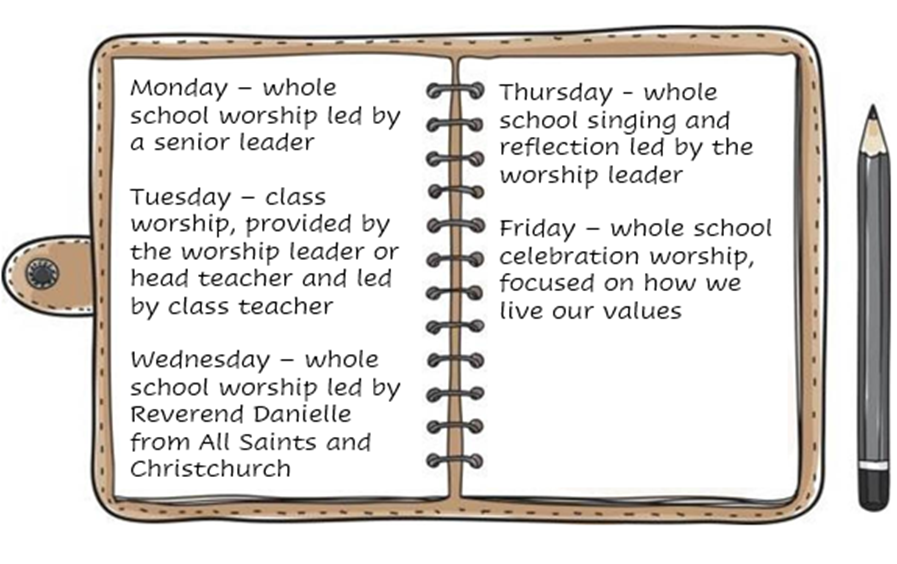
When other events are scheduled, worship takes place in class to ensure that every day still includes a Christian act of collective worship, even when a secular assembly is also taking place.
Spirituality in Worship
All Collective Worship is rooted in spiritual development, aiming to help children develop their own world view and their concept of who they are and how they fit into the world. We mainly talk about this in terms of Windows, Mirrors and Doors: Worship is built around looking outwards at the ‘ows and wows’ of the world and using the lens of Christian scripture to build understanding of these; looking inwards to develop empathy and reflective skills; and taking action, especially in our class worships. These often involve an activity which builds on whole school worship and enables pupils to ‘do’ rather than just passively observe and reflect.

What Daily Worship Looks Like
As a Christian school, we follow a Christian liturgy for worship; if you attend daily worship you should expect to see:
- The lighting of three candles, accompanied by our welcome greeting: We light these candles in the name of the Father, Son and Holy Spirit. Jesus the Light of the World is here. Lord Jesus, shine upon us.
- Opportunities to ‘look outwards’, with a focus on the week’s theme.
- Opportunities to consider the theme through the lens of Christian scripture, by sharing a Bible verse or story.
- Opportunities to reflect by ‘looking inwards’ – what do you think about this theme, what do you feel, what might others feel?
- Opportunities to consider how you could ‘take action’ in relation to this theme.
- Opportunities to actively participate in worship.
- Opportunities to worship through singing hymns
- Opportunities to pray
- A closing to accompany the blowing out of the candles: May the peace of the Lord be always with you. And also with you.
- Although worship follows a Christian pattern, we aim to make it:
- Inclusive – we want all pupils and adults, regardless of personal worldview or faith, to feel that they can be part of collective worship and gain from it.
- Invitational – we want all pupils or adults to feel that they can choose to participate in those parts of worship that they wish to, without feeling forced.
- Inspirational – we want all pupils and adults to leave worship changed in some small way, so that each worship helps every person present to grow spiritually.
Church Services
In addition to Daily Worship, we also have three church services to celebrate key Christian festivals: Harvest, Christmas and Easter. At the end of the year, we also have a special service to say goodbye to our Year 6s. These services are planned, written and led by the children, with our Leading Lights team establishing the theme, overall plan and script, and a team of children from each year group planning and leading a section of the service.
Leading Lights
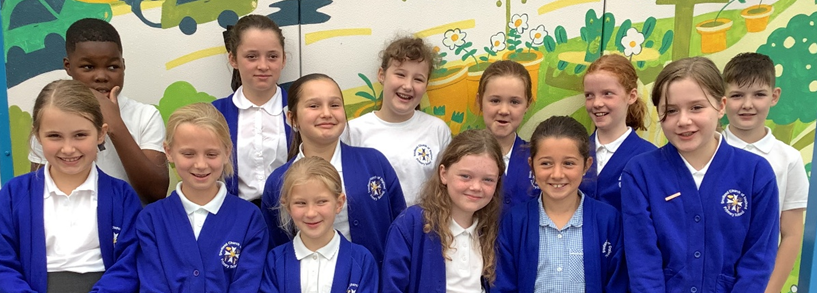
Leading Lights are a team of Key Stage 2 children who are involved in all things Christian. A few of the ways in which they lead our Christian school are:
- Opening and closing daily worship
- Choosing hymns
- Suggesting themes
- Planning and leading church services
- Planning and leading worship
- Setting up prayer and reflection stations
- Planning and setting up reflection experience days
- Evaluating worship
- Communicating with parents through the ‘This Week in Worship’ section of the newsletter
- Collecting pupil voice
- Introducing the concept of courageous advocacy (although this has now been handed over to our School Council team)
- Leading involvement with the local church, for example, through the Christmas tree festival