
RE
Why is learning about religion important?
For thousands of years, religion has been the vehicle through which morals, ethics and values have been taught; for three quarters of people around the globe, it provides a framework for living, a sense of purpose and a place in a community. To be able to understand and live peacefully alongside others, it is essential to understand a range of faiths. Through deepening this understanding, our children discover how similar the underlying values and beliefs are, as well as viewing the different ways people express these beliefs positively. Whether an individual has a personal faith or not, learning about the faiths of others is key to creating a tolerant society where different faiths are celebrated and treated with respect.
As well as learning about religion, we aim to learn from religion, exploring those moral and ethical lessons to help children establish their own values and beliefs about right and wrong. Discussion and debate are key aspects of Religion Education, helping children to develop their skills at listening, thinking for themselves, expressing themselves clearly and presenting their thoughts respectfully. Faith stories, scripture and people can help children to explore their own worldview, growing spiritually as they establish what they personally believe, what is important to them and how they fit into the world.
The Religious Education Curriculum
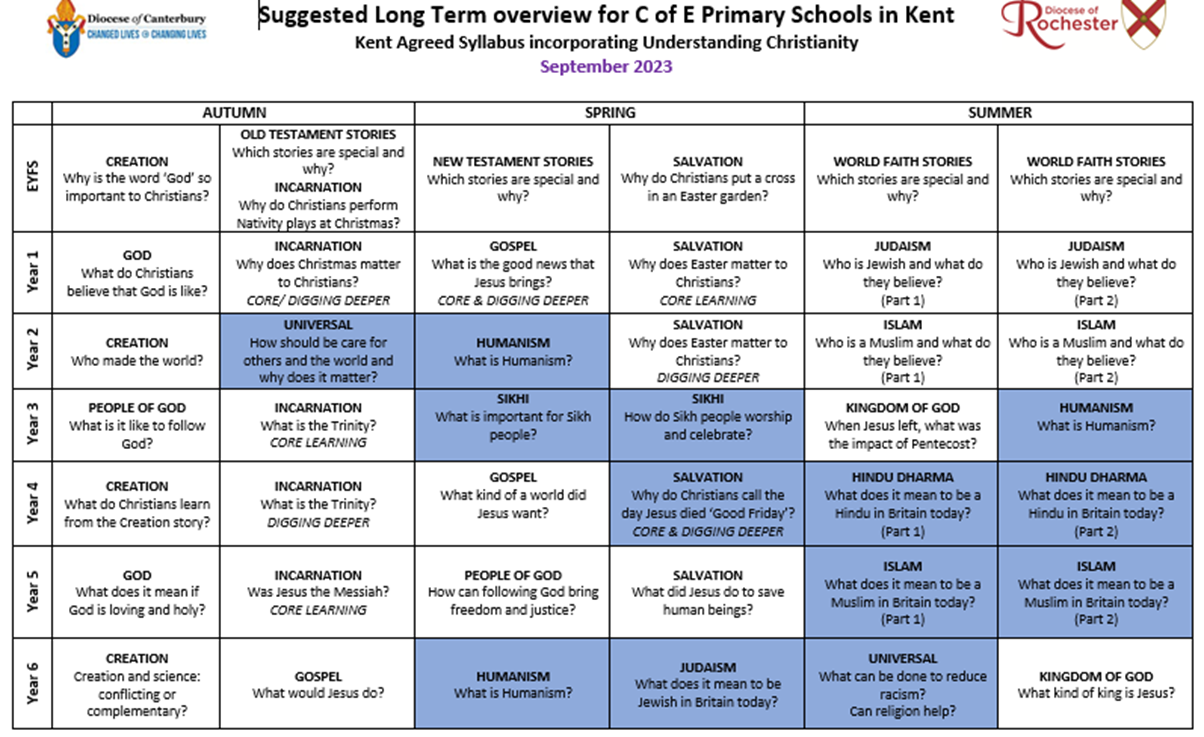
As a Church of England school, we follow the planning recommended by Rochester Diocese. This includes units from the Understanding Christianity resource and units about the other most prevalent religions in the UK which are written and provided by the Diocoese.
A Worldviews Approach
Following the publication of “Developing a Religion and Worldviews Approach in Religious Education in England” by the Religious Education Council of England and Wales, we are taking part in a pilot project involving the creation, testing and evaluation of new RE planning which the Diocese will then provide to other schools. We strongly believe that this approach better reflects the cultural and religious landscape of the UK and the world, and will help pupils to develop their own worldview by making sense of those of others, regardless of whether they have a faith.
The key ideas behind a Worldviews approach are:
- Not everyone has a faith, but everyone has a worldview – their own view of the world, their own beliefs about right and wrong, their own opinions about what matters.
- There is enormous diversity within religions, and enormous overlap between religions; this is not reflected in the current RE curriculum.
- Teaching should engage children by starting from their own personal views, not treating them as an add-on; then it should look at the lived practises and beliefs of real people before looking at religion as a whole. Very little in RE applies to all followers of a faith.
- History, geography and culture have an impact on faith and how it is expressed by different people in different places.
- We should be teaching our children to be theologists, philosophers and sociologists just as we teach them to be mathematicians, scientists or writers – the teaching of skills is just as vital in RE as in every other subject.
What an RE Lesson looks like
An RE lesson in our school...
- Is pacey and interactive throughout
- Engages children by starting with their own views and experiences
- Involves plenty of opportunity for discussion
- Includes group or paired activities
- Encourages children to find things out for themselves using real sources: artefacts, photographs, scripture, videos, art, music
- Uses ‘windows, mirrors, doors’ to explore and reflect on beliefs
- Allows children freedom of expression
- Makes connections between faiths
Visits and Visitors
In our school we recognise that a key element of helping children understand a faith is to explore places of religious importance and to meet and talk to real people of faith. Our children have at least one opportunity every year to visits a place of worship, and we invite visitors to school to speak to the children about their beliefs and practises. These visits do not involve any form of worship by the children, but enable them to see and experience others worshipping in their own way. An overview of RE trips can be seen below, but we are constantly adding to our program to broaden the children’s horizons further.
|
Autumn Terms |
Spring Terms |
Summer Terms |
|
|
Year 1: St Pauls’ Cathedral Year 5: Guided walk around Maidstone churches, including visit to Catholic church Year 5: Big Bang event at Rochester Cathedral |
FS: Local churches walk Year 1: Church tour at The Friars, Aylesford Year 2: Rochester Cathedral Year 3: Gravesend Gurdwara Year 5: Performance at Rochester Cathedral |
Year 1: Chatham Synagogue Year 2: London Central Mosque Year 4: Neasden Hindu Temple Year 6: All Saints Church, Snodland |
|
Assessment
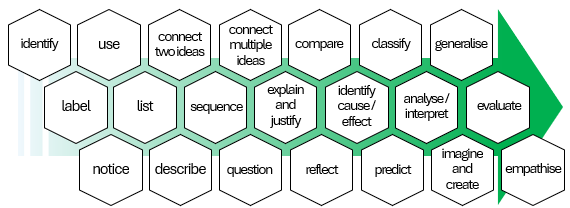
We assess children three times a year in RE. Assessment is based partly on the learning in their books, but is also complimented by a ‘hexagons assessment’ where children are invited to talk freely about the ideas they have learnt about; making their own connections, showing the depth of their knowledge and demonstrating their skills. Although progress in RE is not linear, we articulate our expectations of how children will progress through two diagrams, shown below.
Substantive knowledge (what children know about religion)

Disciplinary Knowledge (RE skills)
* parents and carers have the right to withdraw their child from all or part of RE but in the first instance, a meeting with the Headteacher should take place to discuss